Compliance / ISO 27001
From Essential 8 to ISO 27001: when the jump is worth it for a Sydney SMB
By InfosecSphere teamPublished 15 min read
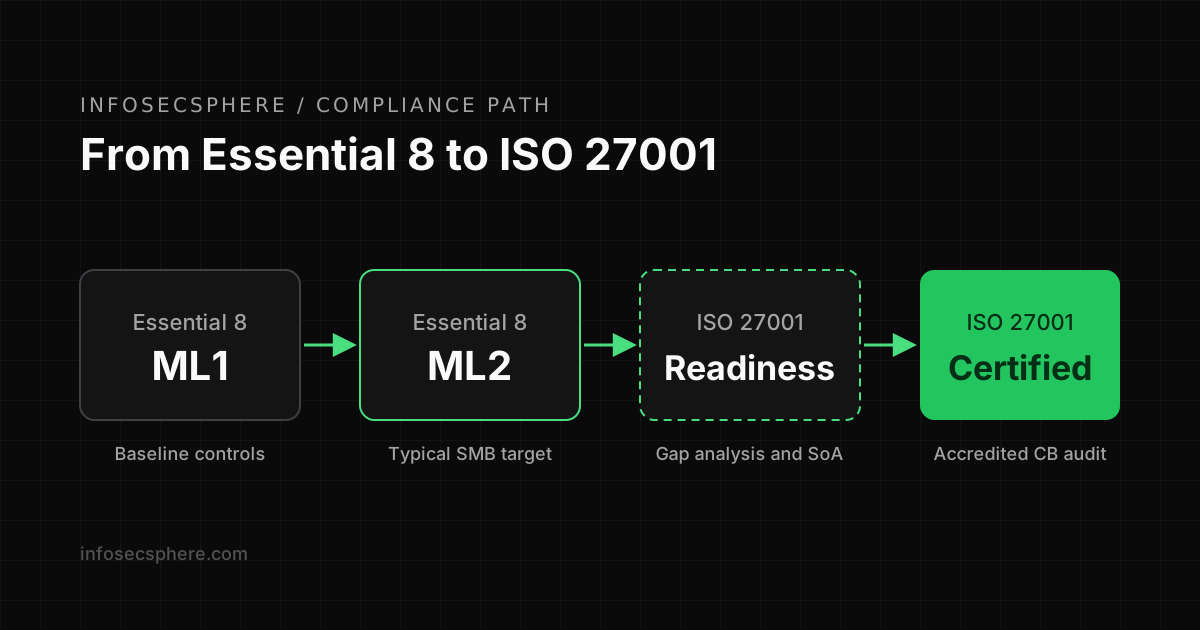
Most Sydney SMBs that reach Essential 8 Maturity Level 2 then face a question: do we invest another 6-12 months to go for ISO 27001 certification, or is where we are good enough? The answer depends on who your buyers are, not on your security posture. Here is an honest decision framework, including the realistic timeline, cost, and the three mistakes most commonly seen in failed certification projects.
Why Sydney SMBs who hit Essential 8 ML2 start asking about ISO 27001
The pattern is consistent. A Sydney SMB spends 12 to 18 months implementing Essential 8 Maturity Level 2. Patching cadence is enforced. Application allowlisting is deployed. Multi-factor authentication covers every workforce account. The audit log tells the story: incidents have reduced, the IT team sleeps better, and the directors tick a cyber-ready box in the board pack.
Then a new buyer or an existing enterprise client sends a security questionnaire. Twenty pages in, they ask: "Please provide your ISO 27001 certificate." The firm doesn't have one.
Common triggers include:
- An enterprise RFP where ISO 27001 is a hard filter (banking, insurance, large retail procurement)
- A government tender with a security clause referencing ISO 27001:2022
- A supply chain audit from a listed customer flowing their own compliance requirements downstream
- A board member who sat on another board that mandated it after an incident
- An investor who wants compliance signalling before a Series A or B round
- A move into UK or EU markets, where ISO 27001 is often the baseline buyers expect
The reflex response is to treat ISO 27001 as the next rung up from Essential 8 and start a project. Sometimes that's correct. Often it isn't. Essential 8 and ISO 27001 solve different problems, and understanding the gap matters more than chasing the badge.
What Essential 8 covers vs what ISO 27001 covers
Essential 8 is a prescriptive set of eight technical mitigations published by the Australian Signals Directorate. Each has four Maturity Levels (ML0 through ML3), with ML2 being the realistic target for most SMBs that process sensitive data but are not under nation-state adversary pressure.
The eight mitigations:
- Application control
- Patch applications
- Configure Microsoft Office macro settings
- User application hardening
- Restrict administrative privileges
- Patch operating systems
- Multi-factor authentication
- Regular backups
Hit ML2 across all eight and your firm has a strong technical baseline against the attack chains that cause most Australian incidents.
ISO 27001:2022 is a different thing. It's an international standard for an Information Security Management System (ISMS), not a set of controls. The core of the standard is clauses 4 to 10, which mandate: understanding your organisational context, leadership commitment, risk assessment, defined controls, operational procedures, performance measurement, and continuous improvement.
Annex A of ISO 27001:2022 lists 93 controls (down from 114 in the 2013 version) across four themes: Organisational (37 controls), People (8), Physical (14), and Technological (34). You do not have to implement all 93. You document which ones apply to your organisation, which don't, and why in a Statement of Applicability (SoA).
The gap between the two:
- Essential 8 tells you what to do technically. ISO 27001 tells you how to decide what to do, document the decision, measure whether it's working, and improve it.
- Essential 8 is a checklist against eight mitigations. ISO 27001 is a management system that happens to include a controls catalogue.
- Essential 8 is rarely audited (ASD doesn't audit you; your own IT does, or you self-attest). ISO 27001 is externally audited by an accredited certification body annually.
Where they overlap: many Essential 8 controls map directly to ISO 27001 Annex A technological controls. If you're at ML2, you've already implemented roughly 30-40% of the Annex A technological controls. Starting from ML2 shortens the ISO 27001 project significantly compared to starting from zero.
When ISO 27001 is worth it, and when Essential 8 is enough
The question worth asking when a Sydney SMB mentions ISO 27001 is: who is asking you for it?
When ISO 27001 is worth the investment:
- One or more enterprise or government buyers requires it in procurement, and you have a realistic chance of winning that work in the next 12 months. The badge pays for itself through one or two contracts.
- You're expanding into UK, EU, or Singapore markets where ISO 27001 is the baseline buyers expect. GDPR and similar regimes make the SoA mindset useful anyway.
- You're pre-Series A or B and investors are asking about information security maturity. ISO 27001 is the shortest credible answer.
- You handle data where regulators specifically call out ISO 27001 or an equivalent ISMS (parts of financial services, health, critical infrastructure).
- You're in a supply chain where your largest customer's own compliance (SOC 2 Type II, HITRUST, PCI DSS Level 1) pushes requirements downstream.
When Essential 8 ML2 is enough for now:
- All your customers are SMBs or mid-market, and none have formally requested ISO 27001 in the last 18 months.
- You're resource constrained and the opportunity cost of a 6 to 12 month certification project outweighs the business pipeline it would unlock.
- You already have a SOC 2 Type II report. There is significant control overlap, so pursuing ISO 27001 in parallel may be redundant unless specific buyers insist on it.
- You're in a vertical where the enterprise buyers accept Essential 8 ML2 attestation as sufficient (common with Australian government agencies that reference Essential 8 directly).
The hybrid option few consultancies mention:
You can structure an ISO 27001 Statement of Applicability so your current Essential 8 ML2 controls form the backbone of the technological control set. This gives you an "ISO 27001 readiness" posture, a documented ISMS, risk register, SoA, and operational procedures, without going for formal certification yet. If a buyer later asks for the certificate, you're 3 to 4 months from certification instead of 9 to 12.
This path suits many SMBs that think they need ISO 27001 today but actually need a 12-month runway. It also protects against the scenario where you spend AUD 60,000 on certification and lose the specific deal that justified it.
What "accredited certification" actually means in Australia
If you decide to pursue certification, choosing the right certification body matters more than most SMBs realise.
Accreditation vs certification:
- An accreditation body accredits certification bodies to issue certificates. In Australia and New Zealand, this is the Joint Accreditation System of Australia and New Zealand (JAS-ANZ).
- A certification body (CB) audits your organisation against ISO 27001 and issues the certificate. For the certificate to carry international recognition, the CB must be JAS-ANZ accredited, or accredited by another IAF Multilateral Recognition Arrangement signatory such as UKAS (United Kingdom) or ANAB (United States).
- The certification body process is governed by ISO/IEC 17021-1, which sets requirements for competence, impartiality, and consistent audit conduct.
JAS-ANZ accredited certification bodies operating in Australia include:
- BSI Group
- Intertek SAI Global
- DNV
- LRQA
- SGS
- DQS
- TUV SUD
The current full list is published on the JAS-ANZ directory. Always verify a CB's accreditation status before engaging them for a Stage 1 audit.
"ISO 27001 compliant" is not the same as "ISO 27001 certified."
Any consultancy can help you implement ISO 27001-aligned practices and call your organisation "compliant" with the standard. Only an accredited CB can issue a certificate that enterprise and government buyers will accept as evidence.
Watch out for:
- Non-accredited consultancies issuing "ISO 27001 certificates" that are not recognised in procurement
- "Internal certifications" or "pre-certifications" that have no formal standing
- Overseas CBs that are not IAF signatories; their certificates may not be recognised by Australian buyers
The certification cycle:
- Year 1: Stage 1 audit (document review) and Stage 2 audit (on-site assessment), then certificate issued, valid for 3 years from issue
- Year 2: First annual surveillance audit (lighter touch; focuses on continual improvement and specific risks)
- Year 3: Second annual surveillance audit, followed by a recertification audit before the certificate expires. Recertification is full scope, equivalent to a repeat Stage 2.
Once certified, your certificate is listed on the JAS-ANZ public register, which enterprise buyers often check as part of their vendor onboarding process.
Realistic timeline and investment
Here's a realistic timeline for a Sydney SMB with 20 to 100 employees, starting from Essential 8 ML2, who wants ISO 27001 certification.
Total elapsed time: 6 to 12 months, depending on internal capacity and scope.
Phase 1: Readiness assessment (weeks 1 to 4)
A consultancy maps your current state (Essential 8 ML2, existing documented procedures, any ad-hoc security practices) against the full ISO 27001:2022 standard. Deliverables: a gap analysis, prioritised remediation roadmap, estimated internal resource requirement, and a Statement of Applicability draft. Investment: AUD 10,000 to 15,000.
Phase 2: ISMS implementation and gap remediation (months 2 to 6)
Build out what's missing: the risk assessment methodology and register, the Statement of Applicability finalised, policies for the controls your SoA calls out as applicable, operational procedures for incident response and change management, internal communications and training. Essential 8 ML2 covers roughly 30 to 40% of the technological Annex A controls, so most of this work falls on the Organisational, People, and Physical themes. Investment: AUD 15,000 to 35,000 consultancy plus 150 to 300 hours internal time.
Phase 3: Internal audit and management review (weeks 20 to 24)
ISO 27001 requires an internal audit before the external audit, conducted by a competent auditor who is independent of what they are auditing. For most SMBs, this means a consultant performs the internal audit. Then a formal management review (minuted) covers the audit findings, risk register, and improvement actions. Investment: AUD 3,000 to 6,000.
Phase 4: Stage 1 audit by certification body (weeks 24 to 28)
The CB reviews your documentation remotely or in a short site visit. They identify any major non-conformities that would block Stage 2. You get 30 to 60 days to address them. Investment: part of the overall CB fee.
Phase 5: Stage 2 audit by certification body (weeks 28 to 32)
Full on-site assessment, typically 2 to 5 audit days depending on scope. The CB tests whether the ISMS operates as documented, interviews staff, samples records, and issues findings. Investment: AUD 10,000 to 25,000 total CB fee for a small-to-mid SMB.
Phase 6: Certificate issued (weeks 32 to 36)
The CB issues the certificate, which lists your scope statement (which parts of your business are covered). You can now reference it in RFPs and buyer questionnaires, and your name goes on the JAS-ANZ register.
Ongoing: Annual surveillance audits
Year 2 and Year 3 surveillance audits: AUD 5,000 to 12,000 each. Year 3 recertification audit: similar to Stage 2 cost.
Total first-year investment, typical Sydney SMB with 20 to 100 staff:
- Consultancy (phases 1 to 3): AUD 25,000 to 55,000
- Certification body fees (phases 4 to 5): AUD 10,000 to 25,000
- Internal staff time: 150 to 300 hours across the project
- All-in range: AUD 35,000 to 80,000
Figures vary with scope, number of sites, complexity of data flows, and whether you use a mid-tier CB or a top-tier one. The hybrid "ISO 27001 readiness" path mentioned earlier costs roughly AUD 20,000 to 35,000 and takes 3 to 5 months, with no CB fees until you decide to pursue certification.
Three common mistakes in failed ISO 27001 projects
Mistake 1: Treating ISO 27001 as a document exercise
Failed ISO 27001 projects commonly share this symptom: a consultant produces 40 Word documents, hands them over, the firm files them, and starts the Stage 1 audit. The CB opens three documents at random, finds them not reflected in day-to-day practice, and raises major non-conformities. The firm then scrambles to retrofit practice to match the documents.
ISO 27001 is a management system. The documents describe what you do. If you don't actually do it, the documents are useless. Build the practice first, document what the practice is second.
Mistake 2: Skipping or rushing the risk assessment
Many SMBs reach for the Annex A controls list and start implementing from the top, treating it as a checklist. ISO 27001 doesn't work that way. The risk assessment is upstream of the Statement of Applicability, and the SoA justifies which controls apply.
A rushed risk assessment produces a generic SoA. A generic SoA produces a disconnect between the controls you implement and the risks you actually face. The CB will see this immediately in Stage 2 and raise findings on your risk methodology.
Give the risk assessment real time. Interview actual asset owners. Document the methodology before you populate the register. The hour spent on methodology saves five hours in Stage 2.
Mistake 3: Choosing a certification body before readiness is complete
Enthusiasm pushes some SMBs to book Stage 1 immediately after signing a consultancy engagement. The CB's calendar fills 2 to 3 months ahead, so booking early feels sensible. Then the readiness assessment finds you're 6 months from ready, and you've committed to a Stage 1 you can't pass.
Instead: run the readiness assessment first. Based on the gap analysis, estimate your realistic Stage 1 date, add 3 to 4 weeks buffer, then book the CB. Trying to work backwards from an arbitrary date creates rushed decisions downstream.
Also worth avoiding:
- Not getting executive sponsorship at the start. ISO 27001 touches HR, legal, operations, and IT. Without a CEO or similar as sponsor, the inevitable cross-team requests stall.
- Underestimating the ongoing cost. Year 2 surveillance and Year 3 recertification are not free. Budget for the full 3-year cycle, not Year 1 alone.
- Letting your Essential 8 posture slip during the ISO 27001 project. The two are complementary; don't trade one for the other.
What to do next
The fastest path to a sensible yes/no decision on ISO 27001 is a readiness assessment. Not a sales pitch disguised as a scoping call. An actual assessment that tells you how far from certification you are, what it would cost, and whether the business case holds up.
The deliverable is a document you can take to your board or your buyer and have a specific conversation about compliance posture, instead of a vague "we're working toward it."
If you're not yet at Essential 8 ML2 and want to start there first, our Essential 8 Assessment service is a better entry point: Learn more about Essential 8 Assessment.
FAQ
Q: Do we need to hit Essential 8 ML3 before starting ISO 27001?
No. ML2 is a solid technical baseline that covers roughly 30 to 40% of the ISO 27001:2022 Annex A technological controls. ML3 is designed for organisations under adversary pressure from sophisticated threat actors (nation-state, advanced persistent threats), and is overkill for most SMBs. Start ISO 27001 from ML2.
Q: Can we go straight to ISO 27001 without Essential 8 at all?
Yes, but it's harder. Essential 8 ML1 maps to many ISO 27001 Annex A technological controls, so skipping it means more remediation during Phase 2. For most Sydney SMBs, we recommend reaching Essential 8 ML1 at minimum before starting the ISO 27001 project.
Q: How long does certification last?
The certificate is valid for 3 years from issue. Annual surveillance audits in Years 2 and 3 confirm the ISMS is being maintained. A full recertification audit before the certificate expires renews it for another 3 years.
Q: What's the difference between Stage 1 and Stage 2 audits?
Stage 1 is a documentation review. The CB confirms your ISMS is documented and ready for a Stage 2 audit, and identifies any major non-conformities to fix first. Stage 2 is the full on-site assessment where the CB tests whether the ISMS operates as documented, interviews staff, samples records, and makes the certification decision.
Q: We have ISO 27001:2013. Do we need to transition to :2022?
Yes, and the deadline has passed. The transition period for existing ISO 27001:2013 certificates ran until 31 October 2025. All current certifications must be against ISO 27001:2022. A :2013 certificate on paper is no longer recognised as current.
Q: Does ISO 27001 satisfy APRA CPS 234?
ISO 27001 covers many of the information security requirements in CPS 234, but is not sufficient on its own for APRA-regulated entities. CPS 234 has specific requirements on board responsibilities, incident notification timelines, and third-party assessments that go beyond ISO 27001. For APRA-regulated entities, ISO 27001 is a strong foundation but not a complete answer.
Q: Can one certificate cover multiple business entities or sites?
Yes, if they share a single ISMS. The scope statement on your certificate names the entities and sites covered. If you add new sites or acquire new entities, the scope needs updating and the CB may require a scope extension audit.
Q: What happens if we fail Stage 2?
Failing Stage 2 with major non-conformities means the CB does not issue the certificate. You have a defined period (usually 90 days) to remediate the findings, after which the CB verifies the fixes (sometimes remotely) and then issues the certificate. Projects rarely fail outright at Stage 2 if the readiness assessment and Stage 1 audit were done properly.
Q: Can we use the certificate in marketing immediately?
Yes, once issued. There are specific rules about how you can use the ISO 27001 mark (set by your CB in your certification agreement). Typically you can reference your certification in RFPs, your website, email signatures, and marketing materials, but you cannot imply certification of products, only of the ISMS covering the specified scopes.